

Read the full paper (IEEE Access, open access)
Authors: Dara Molloy, Patrick Müller, Brian Deegan, Darragh Mullins, Jonathan Horgan, Enda Ward, Edward Jones, Alexander Braun, and Martin Glavin (University of Galway, Hochschule Düsseldorf, and Valeo).
Published in IEEE Access, vol. 12, pp. 3554–3569, 2024. doi:10.1109/ACCESS.2023.3348663
Summary
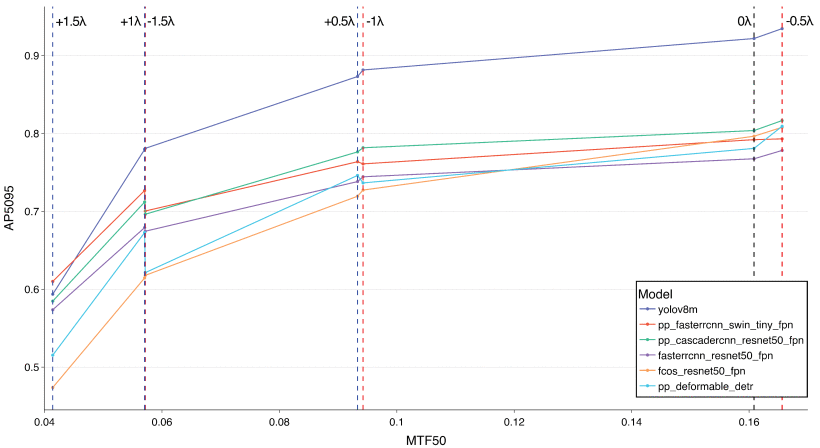
Camera-based object detection underpins ADAS and autonomous driving, and how sharp the camera has to be is a question with direct safety consequences. This study measures that relationship rather than assuming it. Six current object detection models were run against a purpose-built raw dataset of pedestrians and cars at distances out to 100 m, captured across a range of lens defocus levels, and the minimum spatial frequency response (SFR) needed for reliable detection was derived for each case.
The headline result is that the relationship between detection performance and lens blur is considerably more complex than earlier work suggested. Real lenses do not defocus uniformly: field curvature, chromatic aberration, and astigmatism all shape how blur varies across the field, so a single global sharpness figure does not describe what the detector actually sees. The authors also report that smaller objects are disproportionately affected by blur, and that the detection models themselves differ markedly in how robust they are to it.
Why it matters for camera testing
Two of these findings line up closely with work we have been pursuing. The first is that a single summary sharpness number is not sufficient to predict machine vision performance. That is the same conclusion we reached comparing MTF50 against detection confidence in Validating Information Metrics Correlation with Object Detection. The second is that blur has to be characterized across the field rather than at a single point, because the aberrations that dominate off-axis are exactly the ones that move the detection result.
The overlap is not only thematic. Several of the authors (Brian Deegan, Dara Molloy, Enda Ward, Edward Jones, and Martin Glavin) are part of the University of Galway group we have worked with on Information Capacity as a Predictor of Perception Performance, which approaches the same question from the information-theoretic side.
See also
- Analysis of the Impact of Lens Blur on Safety-Critical Automotive Object Detection (IEEE Access, open access)
- Information Capacity as a Predictor of Perception Performance
- Validating Information Metrics Correlation with Object Detection
- Image Information Metrics
- Sharpness: What is it and how is it measured?