

Machine vision systems make decisions from images, and image quality sets a ceiling on how reliable those decisions can be. If you don’t catch camera quality deficiencies, they can surface later as missed detections, false positives or negatives, or inspection escapes. Low contrast, insufficient resolution at the working distance, uneven illumination, sensor noise, and motion blur all reduce the information content of an image, affecting performance in ways that may not be obvious from the appearance of the image. Imatest provides the software, test charts, and equipment to measure these factors objectively, so you can specify and validate a camera against numbers rather than impressions.
These challenges affect a wide range of machine vision applications, including object detection, automated inspection, and robotics. Modern systems lean heavily on machine learning and deep learning, from convolutional detectors such as YOLO and classical pipelines built on OpenCV, through to vision-language models (VLMs) that reason about scene content in more general terms. All of them are trained and validated on captured images, and the success of these vision models depends on high-quality input from a validated camera system.
Image Information Metrics (ISO 23654)
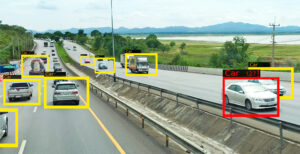
Traditional summary numbers such as MTF50 describe sharpness, but they do not tell you how much usable information a camera actually delivers to an algorithm. Image information metrics apply Shannon information theory to the signal and noise measured from the same slanted edge, producing an information capacity figure that tracks machine vision performance far more closely than sharpness alone. This is the most useful single measurement we can offer a machine vision team, and Imatest is leading the effort to standardize it as ISO 23654, Digital Imaging Information Metrics.
Image Quality Testing Based on Information Metrics is a white paper introducing information metrics measured from slanted edges, such as information capacity (C4), SNRi, ODEP, Information-based Dynamic Range, that predict a camera’s machine-vision object detection better than MTF or noise alone. It begins with a review of image quality testing concepts, then moves on to the new metrics, stressing the importance of making measurements over the image surface (best done with auto-detection Edge SFR charts) and over a wide range of tones (best done with the new InfoDR chart).
Image Information Metrics from Slanted Edges is a white paper that contains a detailed description of how information capacity is mesured from slanted edges, including all relevant equations and algorithms. These metrics are highly predictive of machine-vision performance.
Related reading:
- Information Capacity as a Predictor of Perception Performance
- Information-based Dynamic Range
- Image Sensor Noise Model for Image System Simulation
ISO 24942 (EMVA 1288)
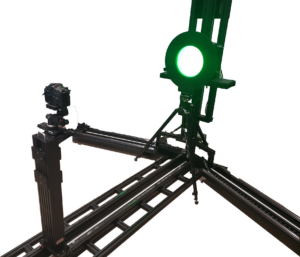
ISO 24942 brings the EMVA 1288 sensor characterization methods into an ISO standard. It specifies how to measure the fundamental behavior of an image sensor, including quantum efficiency, temporal noise, dark current, and the spatial nonuniformities DSNU and PRNU. These are the parameters that decide how a sensor behaves at its limits, which is exactly where machine vision tends to operate: short exposures to freeze a moving line, or poor light in an enclosure. Imatest software produces EMVA 1288 results from captures made in your own lab.
The Uniformity Statistics documentation covers how DSNU, PRNU, and the related statistics are calculated.
Targets and Light Sources for EMVA 1288 Testing
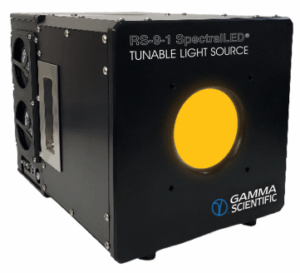
EMVA 1288 measurements depend on illumination that is both uniform and well characterized, because any structure in the light source is indistinguishable from structure in the sensor. Imatest supplies the uniform reflectance targets and the uniform light sources needed to make these measurements repeatable.
Image Sensor Noise: Measurement and Modeling
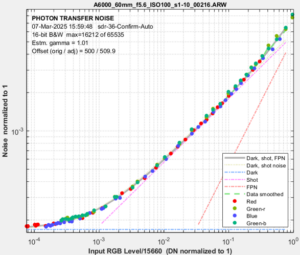
Image sensor noise is measured from raw images, which are undemosaiced and unprocessed. In a uniformly illuminated patch of a raw image, noise is a function of the mean Digital Number (DN), independent of color, so the noise and SNR of every channel fit a single, well-defined curve: the photon transfer curve shown here. The image sensor noise model built from these measurements is the heart of the Simatest Camera/Image Signal Processing (ISP) simulator. It enables camera performance to be characterized and simulated for a wide variety of conditions, especially low illumination levels. The model is compatible, though not fully compliant, with EMVA 1288 measurements, and EMVA results, including the DSNU and PRNU summary metrics, can be used as input to Simatest.
Motion Blur Testing

Motion blur occurs when the camera or the subject moves during exposure, and in machine vision, that movement is often continuous by design. Parts travel past a fixed camera on a conveyor, and a camera mounted to a robot arm or a mobile platform moves with it. The resulting loss of detail cuts the information available to a detection or inspection algorithm at precisely the moment a decision has to be made. Imatest hardware lets you create controlled, repeatable motion in the lab, and Imatest software measures what that motion costs you in sharpness, so you can confirm that exposure time and sensor readout are quick enough for your line speed.
Image Quality Factors
Underneath the standards and the information metrics sit the individual factors that determine what a camera can resolve and how cleanly it does so. Each can be measured on its own and written into a requirements document, which makes them the practical vocabulary for specifying a machine vision camera.