

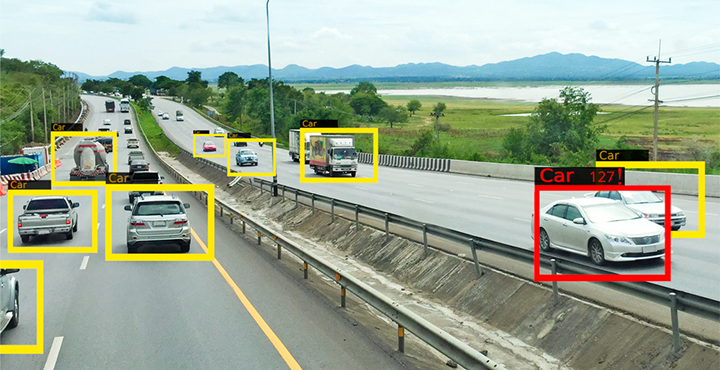
Imatest offers solutions for testing multi-camera automotive systems. With the increasing number of automobile camera system applications such as Advanced Driver Assist Systems and Mirror Replacements, the automotive industry has to test and meet a wide variety of image quality standards. Factors to test include dynamic range, long range focus, contrast resolution, flicker, flare, and sharpness. Many of these cameras serve computer vision rather than a driver’s eyes, as in machine vision. We can provide the necessary solutions, including charts, equipment, and software to test these factors.
We also understand that not everyone’s testing needs are the same. That is why we are always standing by to help you design the solution that is best for you.
Advanced Driver Assist Systems (ADAS)
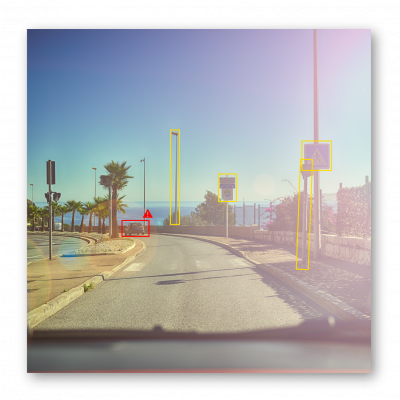
ADAS systems typically contain forward facing camera systems that rapidly analyze oncoming and nearby objects. The lenses on these cameras focus at a long-range to maximize the sensitivity of the system. Unfortunately, this complicates the testing process generally because of the limitations in lab size. Specialized equipment is therefore required to test the image quality at the needed distances.
Our solution includes the necessary charts, equipment, and software to optimize your testing environment; including collimating relay lenses to project a high-resolution image at a virtual distance.
Key image quality factors to be tested include:
Rear View and Surround View Camera Systems
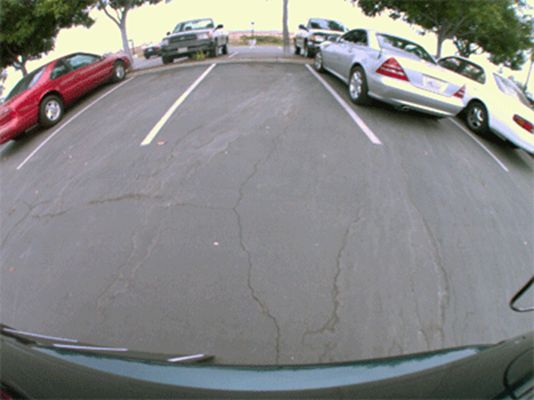
Rearview cameras typically have significant fisheye distortion and a Field of View (FoV) greater than 160°. Surround-view camera systems build upon the rearview camera system by adding side and front cameras. Using lens distortion correction, perspective transformation, and color correction algorithms, the systems can seamlessly integrate all camera images together for a 360° image of the vehicle’s surroundings.
Special equipment and charts are needed to accommodate the wide field of views of these systems. We offer these products including the Modular Test Stand Reflective WFoV Module, and pre-distorted SFRplus charts.
Key image quality factors and features to be tested include:
Mirror Replacement/Camera Monitor Systems (CMS)
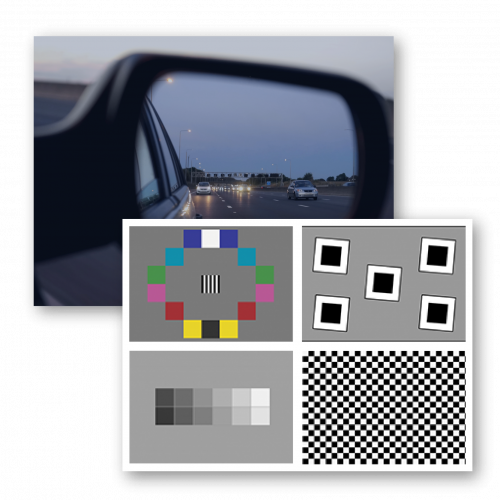
Camera Monitor Systems are challenging to test because several factors in the multi-camera, multi-step process need to be set up correctly. Though the majority of the image quality factors are important, sharpness, contrast resolution, and color accuracy are of the highest importance.
Our solution supports the ISO 16505 test charts and measurements and also offers several improvements to the standard.
Key image quality factors to be tested include:
IEEE 2020-2024 Standard
Published in 2025, IEEE 2020-2024 establishes requirements and objective tests for automotive viewing and automotive computer vision applications: a coherent set of key performance indicators by which camera systems and components may be evaluated in a manner consistent with their intended use. Imatest experts have been involved since the IEEE P2020 working group began in 2016, designing, writing and validating many of its metrics.
Its key performance indicators include:
- Flare
- Geometric calibration validation
- Noise
- Dynamic range
- Spatial frequency response (SFR)
- Flicker
- Contrast performance indicators
Many of Imatest’s existing tools measure IEEE 2020-2024 metrics.

In-Cabin Driver Monitoring Systems (DMS)
Driver Monitoring Systems (DMS) are designed to quickly analyze the driver’s face and eye position to determine their attention to the road in front of them. In order to provide accurate warnings to drowsy or distracted drivers, these monitoring systems require high-precision imaging to follow the driver in different light environments. In addition, the systems will be required to determine the activities of the driver, such as holding a phone(s), smoking, or other distractions. For example, Euro NCAP will, for the first time, start assessing direct driver state monitoring systems, as part of its 5-star rating program.
Using our unique charts and our industry-leading software, you can ensure your cameras will have the necessary quality for your computer vision algorithms to perform optimally.
Key image quality factors to be tested include:
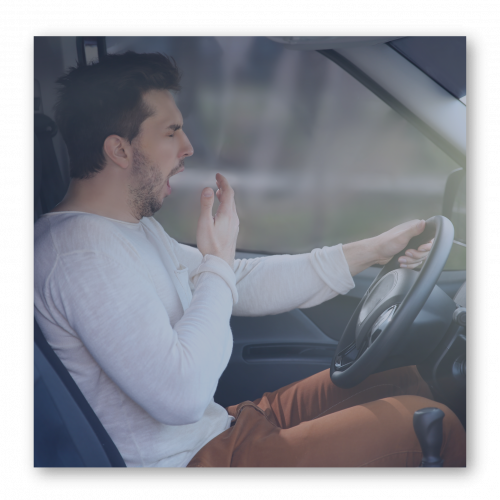
Image Information Metrics
Cameras for driver assistance and autonomous vehicles feed machine vision and AI algorithms, which operate on information, not pixels. Their performance must be measured differently from pictorial images intended for human vision, and sharpness and noise alone are incomplete measures of it.
Image information metrics, derived from Shannon’s information theory, are far more predictive of machine vision performance. They are measured from standard slanted-edge test images (the ISO 12233 4:1 contrast is recommended), and include:
- Information capacity (C): a camera’s potential performance, in bits per pixel or per image.
- Ideal observer SNR (SNRi): how detectable an object is.
- Object detection error probability (ODEP): derived from SNRi, it correlates with how well an object can be detected for a defined task.
Want to know more about Automotive Camera Testing?
Let's work together
Not sure what you need? Talk to an expert.
Our experts are always standing by to answer any questions and make sure that you have the right solution for your unique testing needs.