


Author: Norman L. Koren (Imatest LLC)
Presented March 4, 2026 at the IS&T Electronic Imaging Symposium 2026, in the AVM (Autonomous Vehicles and Machines) session.
Abstract
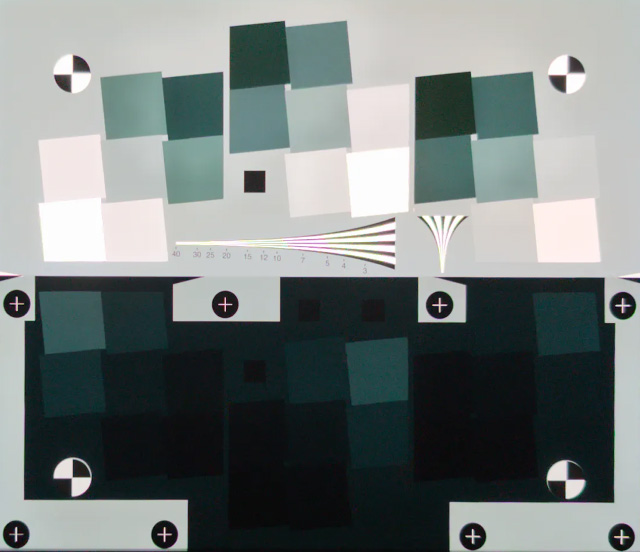
We present a new method for measuring a camera’s Dynamic Range (DR) and low light performance, both of which are derived from C4 information capacity, which is measured directly from ISO 12233-standard 4:1 contrast slanted edges.
The method uses a new test chart that consists of groups of squares in a compact arrangement, where each square differs in transmittance or reflectance from its neighbors by a factor of 4, so that all edges between adjacent squares in a group have a 4:1 contrast ratio (a density step of 0.602).
The major advantage of C4 is that it completely characterizes the performance of cameras for objects with 4:1 contrast, whereas the traditional metrics — signal amplitude, sharpness, and noise, each of which contributes to information capacity — do not individually constitute complete camera performance metrics.
Because the new technique uses the difference in Digital Numbers (DNs) across an edge as the signal for calculating C4, it avoids a measurement issue with simple flat patches, where stray light can be misinterpreted as improved Signal-to-Noise Ratio (SNR), distorting the measurements. It does, however, require that the test chart be well-focused. (The old technique was tolerant of moderate misfocus.)
Finally, we examine a new plot of C4 as a function of exposure, which is a superior representation of camera performance over a wide range of illumination.