

The IEEE P1858 standard for Camera Phone Image Quality has produced two revisions of its Camera Phone Image Quality (CPIQ) standard. This standard focuses on Perceptual Image Quality, which relies on psychophysical studies to quantify how and to what degree image quality degradation is noticeable to a human observer.
The P1858 working group is looking to develop additional metrics to understand further what makes a good-quality image. The development of psychophysical studies is also required to complete the 1858-2023 video quality metrics.
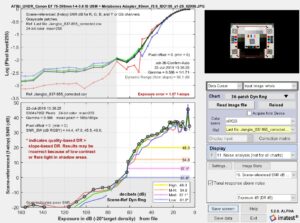 Local Contrast / HDR: A high dynamic range (HDR) scene will need to have local tone mapping applied in order to present it on a lower dynamic range display. Local tone mapping (LTM) may be modeled to emulate the adaptive perception of the human visual system. If not applied optimally, this processing can lead to the loss of mid-tones or an increase of perceptible anomalies. This process is complicated by the proprietary nature of many of the processing algorithms. The P1858 working group seeks to create a method of characterizing the perceptual quality of these local contrast-enhancing image processing techniques.
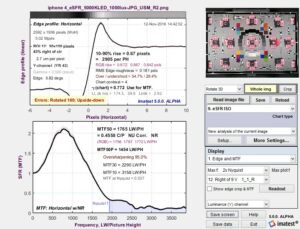
Sharpening Artifacts: For images prepared for presentation to humans, sharpening is typically part of the image processing pipeline. This processing can lead to visible “halo” artifacts around edges which will appear differently depending on the amount of oversharpening applied and the radius of the halo artifact. The P1858 working group seeks to determine the threshold of noticeability, impact on visual quality, and uncanniness that can be side effects of high levels of sharpening in order to guide the creation of more optimal image processing pipelines in the future.
Examples of unsharpened and oversharpened image processing (source: Henry Dietz Quora):
|
Unsharpened image |
Oversharpened Image |
Video Visual Noise: The P1858 working group would like to determine the temporal impacts of noise to extend the still-image-based visual noise metrics from 1858-2016.
Video Jitter JND: IEEE 1858-2023 introduced a new jitter measurement for video. The P1858 working group seeks to determine the noticeability of jitter in real or simulated video recordings and transmissions.
The IEEE P1858 working group is interested in connecting and collaborating with companies and research organizations that are interested in contributing to the work of designing and conducting psychophysical research. This effort will advance the understanding of the human visual system.
Please contact [email protected] if you are interested in participating.
2 May 2023, Boulder, CO. Imatest releases version 23.1 with new updates and features including improved settings in GUI, new slanted-edge-based measurements, EMVA 1288 additions, arbitrary charts video, exposure and distortion support, Gamutvision incorporation, and more.
11 October 2022, Boulder, CO. Imatest releases version 22.2 with new updates and features including Stray Light (Flare) Analysis, Auto Exposure and Auto White Balance measurements in Color/Tone, Compare two images for 3D (stereo imaging) compatibility in Focus Field, and Enhanced image preview.
Imatest is excited to announce we were awarded Best Validation Simulation Tool for our software and charts at AutoSens Brussels 2022. These awards celebrate the best and brightest working at the cutting-edge of innovation in ADAS and autonomous vehicle technology. View the full list of winners here: https://auto-sens.com/events/awards/
September 13th, 2022, Brussels, Belgium, and Boulder, CO. Imatest announced at AutoSens Brussels the release of its new stray light (flare) testing solution, available with Imatest version 22.2.
Stray light, also known as flare, is any light that reaches the detector (i.e., the image sensor) other than through the designed optical path. Stray light can be thought of as systematic, scene-dependent optical noise. Depending on the mechanism causing the stray light, it can produce phantom objects within the scene (i.e., ghosts/ghosting), reduce contrast over portions of the image (e.g., veiling glare), and effectively reduce system dynamic range. These factors can adversely affect the application performance of the camera in a wide variety of applications, including automotive, security, machine vision, and consumer electronics, and are addressed in the upcoming IEEE P2020 standard. The Imatest stray light testing setup allows users to measure stray light for imaging systems.
Maintaining current support on your Imatest license provides access to all new version releases and priority technical assistance from our team of experts. If you have a license with expired Support, renew in through year-end at the In-Support rate and save 40% off the After Expiry renewal price. Take advantage of this offer to access our latest release and all updates for one year. Or transition to a Subscription license and save 30% off the annual subscription price.
Learn more about our newest software features and updates: www.imatest.com/micro_site/imatest_updates/
We are happy to showcase the winners of our internal photo contest. Judged by Nasim Mansurov of photographylife.com, our team submitted over 150 images across 5 different categories. Congratulations to our winners!
Best in Show: Jonathan Phillips