

The High Precision SFRplus Target for GL-30E Lightbox is our most detailed resolution target. You can test high-resolution devices in compact environments using one-third the space required for extra-large Inkjet charts.
New Photographic eSFR ISO
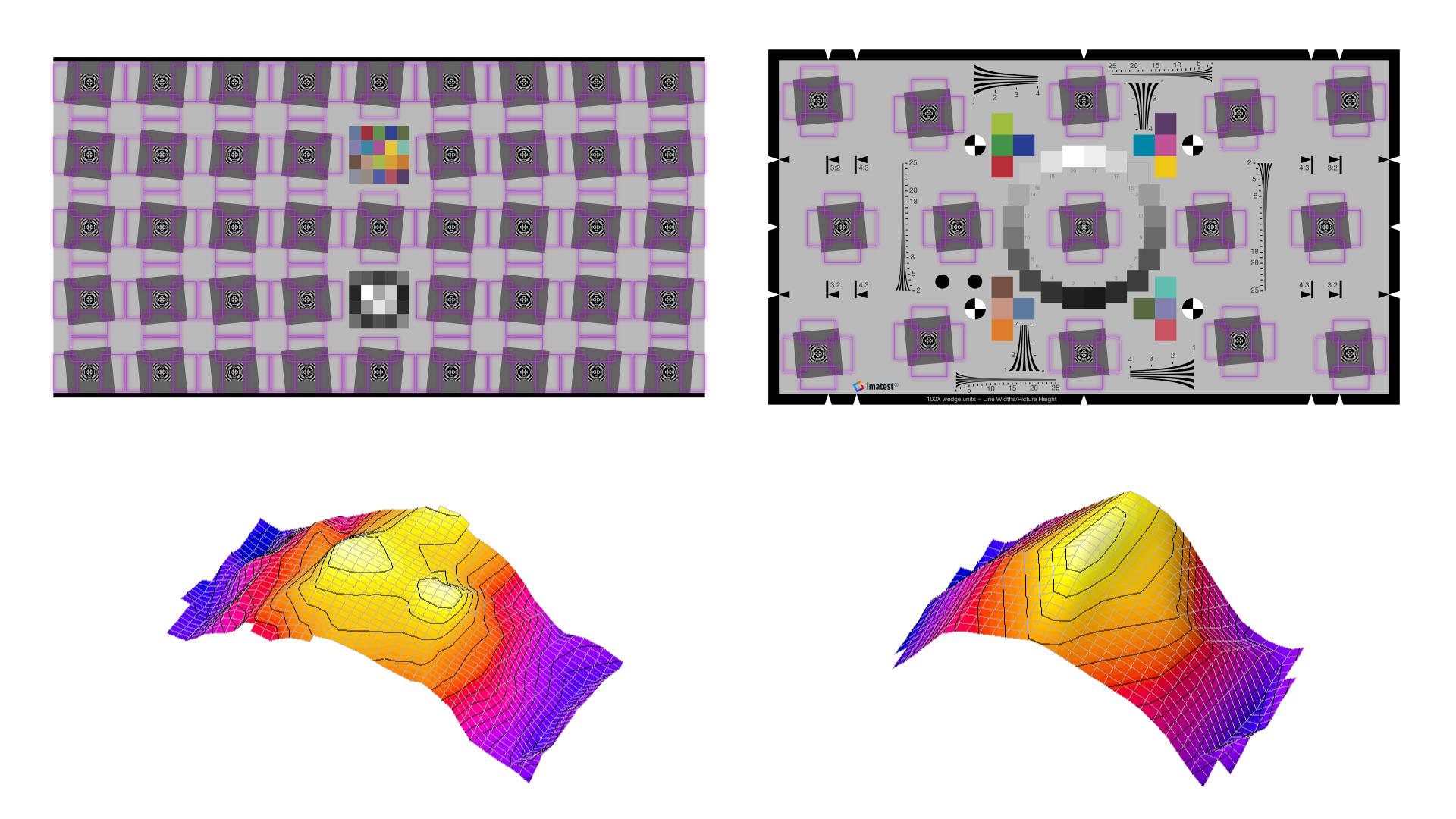
The ISO 12233:2014 Enhanced eSFR Photographic Target is our newest reflective test chart. Photographic prints have over twice the resolution of inkjet prints, making them more suitable for higher resolution camera systems like DSLRs. The photographic substrate will benefit customers interested in testing high-resolution sensors as well as those performing close-range macro tests. (more…)
 New Feature: Imatest IT Parallel
Increasing testing throughput
The new Imatest Industrial Testing Parallel uses parallel processing to improve the throughput of Imatest IT and maximize the image processing power of your computing hardware. IT run in parallel enables up to 3x more throughput to support test equipment that requires a high volume of images to be analyzed. IT-P improves the PPH (parts per hour) on assembly lines.
Infrared Targets
Standard Imatest inkjet-printed test charts produced prior to February 2016 work in Near InfraRed (NIR) wavelengths out to approximately 1 micron.
In February 2016 we upgraded our printers and found (to our disappointment) that our new printers do not have the same reflective densities for NIR wavelengths as for visible wavelengths. We are working out solutions to this issue. Please contact us if your needs include NIR. (more…)
SFRplus and eSFR ISO share many similar features and can be used to perform many similar image quality analyses. However, some of their features differ, and understanding which features differ will help you select the most appropriate test chart to analyze your imaging systems. This video outlines key differences between SFRplus and eSFR ISO.
Measuring MTF is not a typical application for Stepchart— certainly not its primary function— but it can be useful with multiburst patterns, which are a legacy from analog imaging that occasionally appear in the digital world. The multiburst pattern is not one of Imatest’s preferred methods for measuring MTF: see the MTF Measurement Matrix for a concise list. But sometimes customers need to analyze them. This feature is available starting with Imatest 4.1.3 (March 2015).
A correction factor for the slanted-edge MTF (Edge SFR; E-SFR) calculations in SFR, SFRplus, eSFR ISO, SFRreg, and Checkerboard was added to Imatest in 2015. This correction factor is included in the ISO 12233:2014 and 2017 standards, but is not in the older ISO 12233:2000 standard. Because it corrects for an MTF loss caused by the numerical calculation of the Line Spread Function (LSF) from the Edge Spread Function (ESF), we call it the LSF correction factor. (more…)
by Jackson K.M. Roland
Abstract
The slanted-edge method of measuring the spatial frequency response (SFR) as an approximation of the modulation transfer function (MTF) has become a well known and widely (more…)